GAMBIT CHESS BOOKS
Founded 1997 by chess masters and grandmasters •
over 2½ million books sold • More than 200 titles published • Print &
Electronic formats • Translations into 17 languages
Gambit is the world’s
pre-eminent chess book publishing company, founded in 1997 and run
since then by the same team of chess masters and grandmasters.
The company
publishes chess books in three formats:
• Print – the traditional paper format! Buy mail-order from Amazon
• Kindle (electronic editions) – buy from Amazon
• Chess Studio App (electronic editions) – buy from Google &
Apple
Latest updates

26. Juni 2025 – Gambit hat zehn weitere deutschsprachige Titel in
unserem zunehmend beliebten Hardcover-Format veröffentlicht, die
direkt bei amazon.de erhältlich sind: Schach für
Zebras,
Das
Verständnis des Mittelspiels im Schach,
Geheimnisse der modernen Schachstrategie, Geheimnisse moderner
Schacheröffnungen
Band 1,
Band 2,
Band 3 und
Band 4,
Die
Sieben Todsünden des Schachspielers,
Der Weg zur
Verbesserung im Schach und
John Nunns Schachkurs.
26. Juni 2025 – Neun deutsche Bücher werden im Printformat neu
aufgelegt und sind bei Amazon erhältlich. Diese sind
Ein einfaches Eröffnungsrepertoire für Weiß,
Schach für Zebras,
Geheimnisse des positionellen Schachs,
John Nunns
Buch der Schachaufgaben,
365 Wege zum Schachmatt,
Schachendspiele
in der Praxis,
Instruktive Meisterwerke aus der modernen Schachpraxis,
101 Angriffsideen
im Schach und
Jon
Speelmans Buch der Schachaufgaben.

26th June 2025 – We have issued a further batch of books in our
increasingly popular harcover format. The following hardback titles
are now available direct from Amazon:
The Chess
Endgame Exercise Book,
Secrets of Practical Chess (Enlarged Edition),
Vishy Anand
World Chess Champion,
The Dynamic English,
Secrets of
Positional Chess,
Secrets of Chess Defence,
101 Chess Opening Traps,
A Rock-Solid Chess Opening Repertoire for Black,
Secrets of Attacking
Chess, My
Secrets in the Ruy Lopez,
How
to Build Your Chess Opening Repertoire,
How to Defend in Chess,
Win with the
Stonewall Dutch and
Understanding the
Grünfeld.
17th April 2025 – You may have noticed that Gambit has been a little
quiet recently. The reason is that we have all been working very
hard on producing
PCO: Practical Chess Openings. This is a massive 544-page
single-volume book covering all chess openings. What distinguishes
it from other similar books (including our own
FCO: Fundamental
Chess Openings) is that the author Martyn Kravtsiv has focused
especially on lines which have been developed in the last decade and
are currently popular at both club and elite levels. It is
completely up-to-date and incorporates many interesting suggestions
from the latest generation of neural-network chess engines. The
Gambit Chess Studio app
version is already available and you can pre-order the Kindle
edition from Amazon at
 ,
or
. The print version will appear in July.
27. Januar 2025 –
Schacheröffnungen richtig verstehen,
Einführung in
die Schachtaktik und
1001 Schachaufgaben sind jetzt auch als gebundene Ausgabe
bei Amazon erhältlich.
30th November 2024 – We have greatly expanded our range of hardback
editions. The following hardback titles are now available direct from
Amazon and would make an ideal Christmas present: Mastering the Chess
Openings
volume 1,
volume 2,
volume 3
and volume
4, Understanding
Chess Endgames, Secrets
of Pawn Endings,
The Giant Chess
Puzzle Book,
101 Tips to
Improve Your Chess,
Win with the London
System, Understanding
the Chess Openings,
Chess Strategy in
Action and Secrets of
Rook Endings.
22nd September 2024 – Our reissued title
101 Tips to Improve
Your Chess is now available in print format direct from Amazon at
,
or
.
It is also available in Kindle format at
,
or
.
22nd September 2024 –
The Road to Chess
Improvement and
How to Play Chess Endgames are now available in hardback direct
from Amazon.
20th August 2024 – Our reissued title
101 Tips to Improve
Your Chess is now available in app format for iOS and Android. It
is also available for pre-order in Kindle format (see 23rd July below).
A print edition will follow in due course.
12th August 2024 – Perfect Your
Chess and John Nunn’s
Chess Course are now available in hardback direct from Amazon.

12 de agosto de 2024 – Aprende ajedrez se reedita en tapa dura
y ya está disponible en Amazon:
5th August 2024 – Further congratulations to Gambit director JOHN NUNN,
who played a major part in helping the British team win the World Chess
Problem-Solving Championsip held in Jurmala, Latvia. He also finished
second in the indvidual event and first in the senior (60+) category.
23rd July 2024 – Gambit are reissuing the classic instructional text
101 Tips to Improve
Your Chess by Tony Kosten. It is currently available for pre-order
in Kindle format at
,
or
.
App and print editions will follow in due course.
17th July 2024 – the team at GAMBIT would like to heartily congratulate
our chess Director JOHN NUNN, who has just returned with two gold medals
from the World Senior Team Championship (65+) in Krakow. He now holds,
simultaneously, all four major 65+ titles: European and World individual
65+ championships and, as top board for the English team, European and
World team 65+ championships.
15 de julio de 2024 – Los secretos de la estrategia moderna en ajedrez
se reedita en tapa dura y ya está disponible en Amazon
15th July 2024 – Understanding
Pawn Endgames is now also available in a hardback edition direct
from Amazon.
15. Juli 2024 –
Grundlagen der Schachendspiele ist jetzt auch als gebundene Ausgabe
bei Amazon erhältlich.
12th June 2024 – The print edition of
Chess Highlights of the 20th Century (2nd edition) is now available
worldwide direct from Amazon. This is a greatly expanded and revised
edition of Graham Burgess’s 1999 book, with much instructive new
analysis of some of the classic games from the 20th century. The print
edition of this title is available in both softback and hardback; alternatively,
there are Kindle and app editions.
2nd April 2024 – Our instructive new title
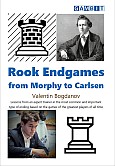
Rook Endgames
from Morphy to Carlsen is available in print format direct from
Amazon, with a choice of softback or hardback editions. The app edition
(for Android and iOS) is also available, and the Kindle edition can
be pre-ordered at Amazon.
9th March 2024 – The print editions of
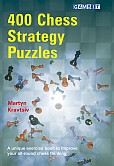
400 Chess Strategy Puzzles
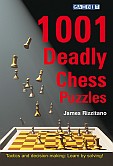
and 1001 Deadly Chess
Puzzles are now available worldwide (direct from Amazon outside
the US and Canada).
17th January 2024 – The print edition of
400 Chess Strategy Puzzles
is now available direct from Amazon outside the US and Canada. The US
print edition will follow later.
15th January 2024 –
400 Chess Strategy Puzzles is now available in Kindle format worldwide
direct from Amazon.
13th January 2024 – Our new title
400 Chess Strategy Puzzles
is now available in app format for iOS and Android. Puzzle books normally
deal with tactics but this one is different and will benefit your all-round
chess thinking. For older news items, see our
Gambit News Archive.
This website is updated regularly and is for information
only. Gambit does not run a direct sales service.
For mail order purchases please use
Amazon who stock the full range of Gambit chess books.
PUBLISHED |
We shall see that even the best players make a surprising number
of errors in rook endings. By emphasizing the most common themes
and areas where players go astray, Bogdanov helps us determine which
parts of those technical endgame manuals that are sitting on our
shelves are most worth thumbing through. This book can also simply
be enjoyed as a stroll through chess history – you will be
amazed how many key turning-points occurred in rook endgames!
The players featured in this book include all 17 official world
champions, the 3 ‘uncrowned kings’ who preceded them,
and a selection of 8 other outstanding players. There are 384 examples
in total. The book is completed with a selection of 68 exercise
positions, and detailed indexes of themes and players.
|
PUBLISHED |
“I noticed that most of the students [at the Lviv chess
school] were pretty good at calculating variations and finding tactical
ideas. But when I gave them a strategic exercise they became a little
confused. ... I realized that few good books of a suitable level
with strategic exercises have been published.” –
Martyn Kravtsiv
This book aims to fill the gap. After tackling
the exercises, you will have a greater understanding of which piece
needs to be exchanged, whether to advance a pawn or leave it where
it is, along with a variety of other strategic questions involving
outposts, open lines, structures and where to attack.
|
PUBLISHED |
This is a true tactics assault course, where you will learn by
solving: the lessons are contained in the puzzles themselves, and
taught by your own effort in solving them. The first four chapters
include a test section, where the positions are a little simpler,
to check what you have learned. They are also designed as revision
exercises, to return to periodically after you have finished reading
the book.
Rizzitano’s puzzles are not just a case of ‘spot
the tactic and move on’. That isn’t good training for
practical play, where you have no idea if a tactic works until you
have analysed it carefully. In some cases it is better to reject
the idea and play a quiet move, while many puzzles require a good
defensive move. Decision-making skills are vital in competitive
chess. And you will definitely need them right away for the book’s
final chapters, ‘Advanced Puzzles’ and ‘Deadly
Puzzles’. Full solutions are provided.
|
PUBLISHED |
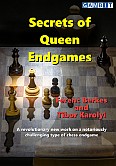
Queen endgames can seem unfathomably complicated. Computers have
provided complete information for some of the basic queen and pawn
endings, but human understanding has proved elusive.
In this
groundbreaking work, two Hungarian authors have gone to extraordinary
lengths to explain strategies and methods in queen endgames. Rather
than a random series of checks, we can now understand king and queen
triangulations that gradually bring the pieces to the squares they
need to be to engineer the killer tactic that completes the process.
Berkes and Karolyi have devised guidelines that help us judge what
we need to aim for, and provided a broad set of tools to help us
achieve these goals.
|
PUBLISHED |
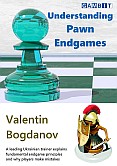
Understanding the endgame is fundamental to playing good chess,
and at its heart lie positions where just kings and pawns remain
on the board. Even when a pawn ending is not actually reached, the
players must often assess ones that could arise from an exchange
of pieces. Experienced Ukrainian trainer Bogdanov examines a wealth
of pawn endings where strong players made significant errors and
draws lessons and rules of thumb from them.While we are enjoying
the entertaining material in this book, we are painlessly absorbing
endgame principles and improving our intuitive decision-making skills.
We learn how to calculate and identify key positional elements,
and appreciate the beautiful tactics and paradoxical ideas that
are unique to the world of pawns.
|
PUBLISHED |
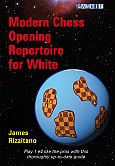
James Rizzitano’s goal in this book is to provide you with
a one-volume, theoretically sound, dynamic opening repertoire beginning
with 1 e4. Studying the choices of the current top players, he identifies
the secrets of their success and incorporates them in his choice
of lines to recommend. The analysis is supported by detailed work
with the current top computer engines. While serious work on chess
openings confirms the basic truth that White can’t simply
force a large advantage from the start position, we can greatly
narrow Black’s path to safety, and tilt the practical struggle
in our favour. To have a chance of half a point, our opponents will
need to solve difficult tactical and strategic problems deep into
the middlegame.
|
PUBLISHED |
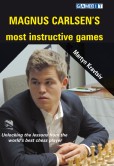
Magnus Carlsen is the greatest chess player of the 21st century.
His tactical wizardry, strategic inventiveness, technical expertise
and legendary fighting spirit put him head and shoulders above all
other players. They also make his games tremendously instructive.
In each game Kravtsiv picks out a key point – the Magnus
Moment – where Carlsen demonstrates the special insight that
sets him apart from other players. The bulk of the book addresses
the fight for advantage and initiative in the middlegame, but there
are also chapters focusing on opening ideas, endgame play and human
factors.
|
PUBLISHED |
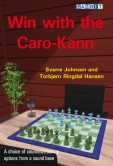
The Caro-Kann is a rare beast among chess openings. While respected
as a sound and safe way to start the game, it also avoids symmetry
or simplification. Two Norwegian opening experts provide a set of
options that take full advantage of this flexibility. In the main
line, you are given a choice between the 4...Bf5 and the 5...exf6
systems – but both strictly in their modern dynamic forms!
The other recommended systems for Black are also aggressive and
very much the ‘21st-century Caro-Kann’. It’s 3...c5
against the Advance, in which Hansen is also an outstanding specialist.
The Panov Attack is answered with ...g6 lines – strategically ideal,
and nowadays backed up by amazing modern computer analysis. This
extremely up-to-date book has an innovative structure, with ‘lessons’,
model games and theory ‘magnifiers’.
|
PUBLISHED |
If you had to choose a single luxury chess item to take to a
desert island, then how about this – a superb selection of 400 puzzles
to solve? Each author has carefully chosen 100 original positions,
graded by difficulty and theme into four sections of 25.
- Wesley So presents 100 puzzles from his
own recent games, many from elite events. They range from easily-overlooked
but straightforward ideas to moves of great depth.
- Michael Adams offers positions from his
files that have inspired him over the years, and includes a
section of ‘warm-ups’.
- John Nunn challenges you to find beautiful
tactics in recent games and studies, as well as some of his
own career highlights.
- Graham Burgess has scoured his work over
the years for hidden unpublished gems, and includes themed sections
on opening tactics and defensive ideas.
|
PUBLISHED |
Everyone knows they should work on their endgame play. So many
hard-earned advantages are squandered in ‘simple’ endings...
But it’s tough finding a way to study endings that doesn’t
send you to sleep and that helps you actually remember and apply
what you have learnt. All major types of endgame are covered, together
with a wide-ranging chapter on endgame tactics. Examples are drawn
from recent practice or from little-known studies. The emphasis
is on understanding and applying endgame principles and rules of
thumb. You will learn by experience, but always backed up by Nunn’s
expert guidance to ensure that the lessons you take away from the
book are correct and useful.
|
PUBLISHED |
Written along similar lines to Gambit’s earlier Ultimate
Chess Puzzle Book, this new work presents 600 puzzles, mostly
from the last two years, that are chosen for instructive value and
maximum training benefit. To ensure that few will be familiar to
readers, Kravtsiv has deliberately chosen positions from obscure
games or from analysis. If you find the right answers, it will be
because you worked them out yourself! The solutions feature plenty
of verbal explanations of the key points, and cover most of the
logical but incorrect answers. The book is completed with a set
of ‘no clues’ tests, and an index of themes that will
be useful to coaches and those looking to focus on specific aspects
of tactics – or just seeking extra clues!
|
PUBLISHED |
Ever wanted a complete chess opening repertoire – for White
and Black – whose basics can be learned in a week? A strategic
low-maintenance repertoire that does not require memorizing of long
variations, and yet can frustrate both stronger and weaker opponents?
In this book, award-winning author Graham Burgess
has come up with the ultimate simplified repertoire. Avoiding boring
or unambitious openings, you will learn how to avoid symmetry and
mass exchanges, and reach an unbalanced middlegame.
With Black, the repertoire is based on the Scandinavian plus a carefully
crafted hybrid of the Slav and QGA. As White it is the English Opening,
often with Botvinnik set-ups.
|
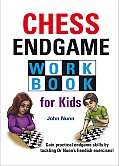
PUBLISHED |
This is a book for those who have started to play chess and want
to know how to win from good positions and survive bad ones. The
endgame is where most games are decided, and knowing all the tricks
will dramatically improve your results. Endgame specialist John
Nunn has drawn upon his decades of experience to present the
ideas that are most important in real games. Step by step he helps
you uncover the key points and then add further vital knowledge.
Each chapter deals with a particular type of endgame and features
dozens of exercises, with solutions that highlight the key points.
For each endgame we are given tips on the themes that are most important
and the strategies for both sides. The book ends with a series of
test papers that enable you to assess your progress and identify
the areas that need further work.
|
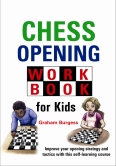
PUBLISHED |
Chess Opening Workbook for Kids is the second in a new
series of books that help players gain chess skills by tackling
hundreds of carefully chosen exercises. The themes are similar to
those in Gambit’s best-selling ‘Chess for Kids’
series, but the focus is on getting hands-on experience. Many positions
build on ones given earlier, showing how advanced ideas are normally
made up of simpler ones that we can all grasp. Each chapter is focused
on a particular theme and features dozens of exercises, with solutions
that highlight the main strategic and tactical points. Each chapter
offers tips on opening play, such as how to detect weaknesses and
poorly-placed pieces. Later chapters address key aspects of opening
strategy such as the centre, development and castling. The book
ends with a series of seven graded tests where you are given few
clues about the themes involved.
|
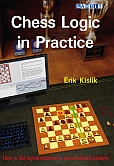
PUBLISHED |
Chess-players understand that it is vital to play logically,
but often lack the methods needed to do so. In this book, renowned
trainer Erik Kislik presents a wide range of specific concepts
that will help them succeed. These include positional techniques,
thinking methods, and modes of play to adopt when either better
or worse. Topics include Painfully Slow Moves, Focal Points, Reciprocal
Logic, Fighting against Centralized Pieces, When Playing a Bad Move
Wins a Good Game and A Chronically Weak King.
Throughout, the
discussion is illustrated by a mass of examples from both recent
elite chess and the play of Kislik and his students, showing how
his themes cut across all levels of chess. After the book’s
two main sections – Thinking Concepts and Positional
Concepts – comes a section of exercises, again with a
strikingly original theme: our task is simply to assess each position.
|
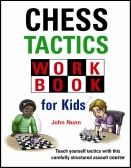
PUBLISHED |
This is a book for those who know the rules of chess and are
keen to start winning games. The quickest way to improve your chess
is to learn tactics. But not just knowing the themes – you
need to get used to using them in real positions. Master tactician
John Nunn has thoughtfully crafted a course that gives you
the basic nuggets of knowledge and immediately invites you to start
finding tactical ideas for yourself.
Each chapter introduces
a basic theme and features dozens of exercises, with solutions that
highlight the key points. In each chapter there are tips on what
to look out for to help spot tactical ideas. As the chapters progress,
we increasingly see how tactical ideas are combined together, with
ideas from previous sections repeatedly appearing as part of a deadly
one-two punch. The book ends with a series of six test papers where
you are given no clues about the themes involved.
|
| |
FOR THE COMPLETE LIST OF GAMBIT BOOKS SEE
HERE
|
|
 PUBLICATIONS